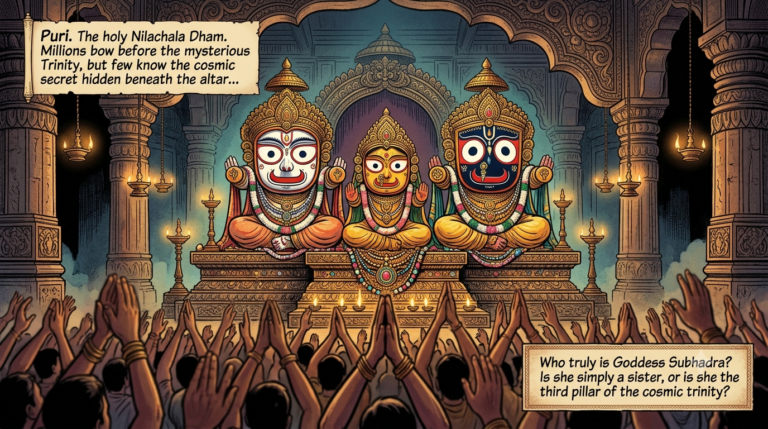
Who truly is Goddess Subhadra? Is she simply the beloved sister of Sri Jagannath and Lord Balabhadra, or is she actually Lord Brahma, completing the cosmic trinity of Brahma, Vishnu, and Maheshwar on the grand altar?
The mesmerizing deities seated upon the Ratna Vedi of the Sri Jagannatha Temple often spark this very question. While some traditions view Goddess Subhadra as the ultimate symbol of Shakti or Goddess Durga, others argue that Subhadra is Lord Brahma himself in a different form. While our ancient scriptures and great saints have meticulously clarified this through logic and sacred texts, revisiting these profound legends helps us uncover the mystery.
At its heart, the transformation traces back to a cosmic curse by Mother Yogamaya. Known as the divine mother and creator of this living universe, her role in this mystery is beautifully expounded by the saint Achyutananda Das’s contemporary, Yashovanta Das, in his scripture Premabhakti Brahma Gita.
In this text, he elaborates that the holy trinity—Sri Jagannath, Devi Subhadra, and Sri Balabhadra—are direct reflections of Vishnu, Brahma, and Maheshwar, respectively. While Sri Jagannath is worshiped as Lord Vishnu and Sri Balabhadra as Lord Shiva (Maheshwar), Devi Subhadra represents Lord Brahma.
But how did the male character and creator of this Universe, Lord Brahma, manifest as the goddess Subhadra and why?
The Brahma Purana describes Sri Jagannath as a complete deity with a fully formed, beautiful body, complete with well-defined hands, feet, a nose, and hair. Furthermore, the Utkala Khanda of the Brahma Purana specifies that both Jagannath and Balabhadra possess four arms, while Devi Subhadra has two. However, the unique, abstract forms we witness today—lacking distinct limbs—are the result of a powerful cosmic decree: the curse of the Divine Mother.
How the purans describe Goddess Subhadra
According to legend, before the material universe was manifested, Mother Yogamaya gave birth to Brahma, Vishnu, and Maheshwar, making them three cosmic brothers. Lord Brahma was assigned the task of populating the Earth with living and non-living entities, creating an environment where humans could be born, grow, and fulfill their divine destinies. Meanwhile, Lord Vishnu expanded his presence everywhere to sustain the creation, and Lord Maheshwar entered deep meditative yoga as Rudra, remaining in a state of eternal childhood.
The Curse
Eons later, Mother Yogamaya entered into an intensely close, intimate spiritual communion with Lord Rudra. Observing this, Lord Brahma and Lord Vishnu grew deeply uncomfortable and criticized Yogamaya. They questioned how a mother could hold such a relationship with her own son.
This criticism deeply angered Goddess Yogamaya. In her fury, she cursed the three brothers to endure mortal births on Earth. Turning specifically to Lord Brahma, she decreed that he would be born as a woman. This cosmic curse found its ultimate fulfillment inside the grand temple of Sri Jagannath in Puri, explaining why the Brahma Purana views the trinity as the living presence of Brahma, Vishnu, and Maheshwar.
The Calf Thief
Providing another fascinating dimension to this story, Sage Shikhar Das offers an alternative narrative in his scripture, the Nila Sundara Gita. He writes that during the Dvapara Yuga, when Lord Krishna was performing his divine pastimes (Gopa Leela), Lord Brahma playfully stole a calf from Krishna’s herd. Disappointed by Brahma’s arrogance, Lord Krishna cursed him to remain unpracticed and unworshipped on Earth.
Terrified of a future without devotees, Brahma begged for forgiveness and sought to appease Krishna. Moved by his earnest prayers, Krishna softened the curse with a profound blessing: Brahma would indeed be worshiped by the entire world in the holy land of Nilachala (Puri)—but alongside Krishna, in the form of Devi Subhadra. Krishna declared that while the deep wisdom of sages would recognize the deity as Lord Brahma, the rest of humanity would see and worship her as Goddess Subhadra. And centuries later, this is exactly what we witness today.